Review Process
A. Peer Review Process
B. Editors’ Guideline
C. Reviewers’ Guideline
A. Peer Review Process
1. Overview
Manuscripts submitted to IJMP will undergo a selection and assessment process by the Board of Editors to ensure their accordance with the writing guidelines, focus, and scope, and that they are of excellent academic quality. The manuscripts will be reviewed using the double-blind peer review method in which case neither authors nor reviewers know each other’s identities.
2. Desk Review
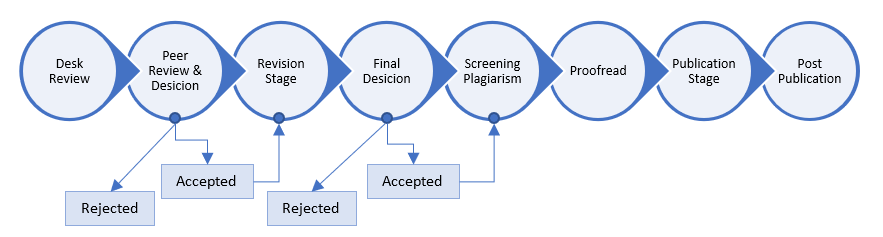
At the desk review stage, manuscripts will be examined to ensure that they have met the writing guideline, focus, and scope with excellent academic quality, and screening plagiarism. Plagiarism screening will be conducted by IJMP Editorial Board using the TurnItIn application with a maximum similarity of 20%. If they do not meet the conditions, the author will be given the opportunity to revise their manuscript according to the given criteria. However, there is also the possibility that the manuscript will be directly rejected.
3. Peer review
When the manuscript has passed the desk review stage, it will then be delivered to two reviewers who are experts in the field of the submitted manuscript. The review process will be done within 3 weeks. Manuscripts that did not successfully pass the desk review process will not proceed to this stage.
Reviewer’s decision. The reviewers will provide the following recommendations:
Accepted means that the manuscript is acceptable for publication.
Accepted with minor revisions means that the manuscript is acceptable for publication once it is revised in response to the reviewers’ concerns.
Accepted with major revisions means that substantive inadequacies in the manuscript, such as data analysis, the main theory used, and rewriting of paragraphs, need to be revised.
Rejected means that the manuscript is not acceptable for publication, or the given reviews relate to very basic issues.
The reviewer’s decision will be considered by the Board of Editors to determine the ensuing process of the manuscript.
4. Revision Stage
Once the manuscript has been received with notations of minor or major revisions, it will be returned to the author with a review summary form. For manuscripts accepted with major revisions, authors are allotted 2-3 weeks to revise. Whereas for manuscripts accepted with minor revisions, 1-2 weeks is allotted for revision. When returning the revised manuscript, the author is required to fill in and attach the review summary form.
5. Final decision
At this stage, the manuscript will be re-evaluated by the Board of Editors to ensure that the author has revised it in response to the reviewers’ concerns. In this final decision, the manuscript may still be rejected if the author did not seriously conduct the revisions necessary.
6. Screening Plagiarism
Before the manuscript undergoes proofreading and publication stage, plagiarism screening will be conducted by IJMP Editorial Board using the TurnItIn application with a maximum similarity of 15%.
7. Proofread
Once the manuscript has been deemed acceptable by the Board of Editors, it will undergo a proofreading process to maintain linguistic quality.
8. Publication Stage
Publication confirmation. At this stage, the final layout of the manuscript will be resent to the author to ensure that the content is in accordance with the author’s writing. At this stage, the author may revise any typographical error found in the final manuscript.
Publication. Once confirmation from the author is given, the Editorial Secretary will process the manuscript for online publication on the website as well as print publication.
9. Post Publication
When the article is published:
The author receives an email alert (if requested).
The link to the published article can be shared through social media.
B. Editors’ Guideline
1. Overview
Manuscripts submitted to the IJMP will undergo a desk review conducted by editors that include analyses and assessments of manuscripts’ acceptability to be processed in IJMP. Editors should consider the following points prior to conducting their review:
- Does the manuscript you are being asked to review match your expertise?
- If the article does not sufficiently match your area of expertise, please notify the Editorial Secretary.
- Do you have time to review the manuscript?
- The review process should be completed within 1 week after a manuscript has been sent. If you do not agree with this condition and need more time to review it, please contact the Editorial Secretary.
- Are there any conflicts of interest with the manuscript?
- If you have any conflicts of interest with the manuscript, please contact the Editorial Secretary.
- Are there any indications of plagiarism in the manuscript?
- If you suspect any indications of plagiarism in the manuscript, please contact the Editorial Secretary immediately.
2. Desk Review Process
- Title: Does it clearly describe the manuscript?
- Has the manuscript met the required journal writing guideline, focus, and scope with excellent academic quality?
- Abstract: Does it reflect the content of the manuscript?
- Introduction: The introduction should contain the general background and research questions or hypotheses. The literature review should be included in the introduction.
- Method: Does the author have used sufficient methods?
- Finding and discussion: Has the author presented research findings and analysed the findings academically?
- Conclusion: has the concluding statement contain a summary and suggestion?
3. Table and Figures
The tables and figures presented should correlate with the article’s content and they should have clear sources of reference (such as books, journals, websites, or other references)
4. References
Please ensure that every reference cited in the text is written in the reference list using the American Psychological Association (APA) style. The references used should be published within the last 10 years, consisting of 80% from journal articles and 20% from books, theses, or other relevant publications.
5. Writing Style
Please write your text in good English that is interesting to read and easy to understand.
C. Reviewers’ Guideline
1. Overview
Manuscripts submitted to the IJMP will undergo a blind review process. The reviewers are tasked to carry out reviews that include analyses and assessments of manuscripts’ acceptability to be published in IJMP. Reviewers should consider the following points prior to conducting their review:
- Does the manuscript you are being asked to review match your expertise?
- If the article does not sufficiently match your area of expertise, please notify the Editorial Secretary.
- Do you have time to review the manuscript?
- The review process should be completed within 2 weeks after a manuscript has been sent. If you do not agree with this condition and need more time to review, please contact the Editorial Secretary.
- Are there any conflicts of interests with the manuscript?
- If you have any conflicts of interests with the manuscript, please contact the Editorial Secretary.
- Are there any indications of plagiarism in the manuscript?
- If you suspect any indications of plagiarism in the manuscript, please contact the Editorial Secretary immediately.
2. Review Process
Tittle
Does it clearly describe the manuscript?
Abstract
Does it reflect the content of the manuscript?
Introduction
The introduction should contain the general background and research questions or hypotheses. The literature review should be included in the introduction.
Content
If the issue relating to the reviewed manuscript has previously been published, is the manuscript sufficient to warrant publication?
Does the manuscript contain novelty, profound knowledge, and interesting points to warrant publication?
Does the manuscript contribute to the development of science and knowledge?
Are the main theories or references used in line with the study?
Method
Does the author accurately describe how the data was collected?
Does the article answer the questions posed in the study?
Are new methods used? If there are new methods, are they explained in detail?
Results and Discussion
The results should explain the findings of the author. This section should be written clearly in a logical sequence. Reviewers need to consider if the appropriate analysis has been conducted.
Conclusion
The conclusion should contain recommendations and a summary of the research. The summary should have examples of answers corresponding to the research objective or the acquired findings. The summary should not contain repetitions of research results or discussions. The recommendations provided should correlate with the concept of the conducted research or suggestions for improving the study.
Final Review
Assessment of the manuscript review should be written in the Review Form sent by the Editorial Secretary. Reviewers are required to fill in the table marked with asterisks. At the end of the review, reviewers are required to give one of the following recommendations:
Accepted means that the manuscript is acceptable for publication.
Accepted with minor revisions means that the manuscript is acceptable for publication once it is revised in response to the reviewer’s concerns.
Accepted with major revisions means that substantive inadequacies in the manuscript, such as data analysis, the main theory used, and rewriting of paragraphs, need to be revised.
Rejected means that the manuscript is not acceptable for publication, or the given reviews relate to very basic issues.
Upon completion of the review form, please fill in the reviewer’s identity in the corresponding columns.